


![2020 Roaring Twenties Winner Badge[44136].jpg](https://static.wixstatic.com/media/c44162_312513fcb3514e3ca71a2a18b458369a~mv2.jpg/v1/fill/w_129,h_52,al_c,q_80,usm_0.66_1.00_0.01,enc_avif,quality_auto/2020%20Roaring%20Twenties%20Winner%20Badge%5B44136%5D.jpg)


Stand-Alone Security Cameras: Pros and Cons for Businesses
If you are responsible for protecting a commercial property, the phrase stand-alone security camera probably sounds appealing. One camera. One job. No complicated ecosystem. No long learning curve.
But here is the truth most business owners find out the hard way: stand-alone cameras can be the right solution in very specific situations, but in many others they quietly create blind spots, frustration, and false confidence.
Stand-Alone Security Cameras for Businesses: Pros and Cons
A stand-alone security camera is typically a single camera or small group of cameras that operate independently. They may record locally, connect wirelessly, or store video on internal media instead of a full video management system.
These cameras are commonly used for:
Temporary sites
Small coverage zones
Supplemental visibility where running infrastructure is not practical
They are not designed to replace a full commercial surveillance system.
Introduction to Stand-Alone Security Cameras
In a business setting, a stand-alone security camera usually checks at least one of these boxes:
No dedicated server
Limited or no integration with access control
Minimal cabling or infrastructure
Faster deployment than traditional systems
Popular commercial-grade manufacturers that support stand alone or semi-stand alone deployments include platforms like Digital Watchdog, Avigilon Unity, Axis, Hanwha, and Eagle Eye.
The appeal is simplicity. The risk is oversimplification.
✅ Advantages of Stand-Alone Security Cameras
Advantage: Ease of Installation
This is the number one reason businesses consider stand-alone cameras.
They are often:
Faster to deploy
Less disruptive to operations
Ideal for locations where trenching or new cabling is not realistic
For warehouses, construction sites, or temporary commercial operations, this can be a legitimate win.
Advantage: Flexibility in Placement
Stand-alone cameras work well when you need eyes in places like:
Remote parking areas
Temporary storage yards
Exterior gates
Construction phases of a property
Wireless and cellular-capable options from vendors like Brivo/Eagle Eye are often used here.
Advantage: Advanced Features Without Full Systems
Many business owners are surprised how capable a single camera can be today. Modern stand-alone cameras can still include:
Motion detection
Night vision
AI-based alerts
Mobile access
Cloud recording options
Advantage: Cost Effectiveness for Limited Scope
A stand-alone camera can be a lower upfront investment compared to a full system buildout if your goal is to monitor:
One entrance
One high-risk area
One piece of equipment
⚠️ Disadvantages of Stand-Alone Security Cameras
This is where reality sets in.
Disadvantage: Limited Coverage Area
One camera sees one angle. That is it.
Most commercial security failures happen between cameras, not directly in front of them. Without layered coverage, blind spots become liabilities.
Disadvantage: Potential Connectivity Issues
Stand-alone cameras often rely on:
WiFi
Cellular data
Internal storage
In commercial environments with metal structures, heavy machinery, or RF interference, connectivity can be unreliable without proper network design using equipment from Aruba Instant On, Cisco, Cambium, or Ubiquiti.
Disadvantage: Dependence on Power Source
No power means no protection.
Battery-powered cameras are convenient but require maintenance discipline. Miss one battery replacement cycle and your coverage disappears quietly. Hardwired cameras reduce this risk but remove much of the “stand-alone” advantage.
Four Main Types of Stand-Alone Security Cameras for Commercial Installation and Use
Wireless Outdoor Security Cameras
Used most often for:
Construction sites
Temporary facilities
Remote perimeter monitoring
They work best when paired with professional-grade networking and mounting strategies.
Outdoor Night Vision Cameras
These are critical for:
Yards
Parking lots
Loading docks
Infrared and low-light performance varies wildly between manufacturers, which is why commercial-grade brands matter.
Wireless Outdoor Motion Sensor Cameras
Motion-based recording saves storage and bandwidth, but can generate false alerts in:
Industrial environments
High-traffic areas
Windy outdoor zones
Professional configuration is key here.
Wired Outdoor Security Cameras
Still considered stand-alone if they:
Record locally
Are not tied to a central VMS
These are more stable but require cabling infrastructure.
Outdoor Surveillance Methods Beyond Cameras
In commercial environments, cameras alone are rarely enough.
True security often combines:
Access control systems
Lighting
Network monitoring
Alarm integration
This is where stand-alone solutions begin to show their limits.
Comparison With Other Security Camera Systems
Stand-Alone vs Integrated Systems
Integrated systems connect cameras with:
Access control platforms like Lenel OnGuard, Avigilon Unity, or Feenics
Centralized monitoring
Incident review tools
Network health visibility
The result is accountability, not just video.
Stand-Alone vs Multiple Camera Setups
Multiple cameras with centralized management allow you to:
Track movement across a site
Reconstruct incidents
Reduce blind spots
Scale as your business grows
Stand-alone cameras do not scale well. In reality, they easily multiply management headaches instead.
Solar Mobile Surveillance Trailers as a Stand-Alone Camera Alternative
For many commercial sites, a single stand-alone security camera is simply not enough. This is where solar mobile surveillance trailers step in as a smarter, more complete alternative.
A solar mobile surveillance trailer is still considered a stand-alone security solution, but it solves many of the limitations that single-camera setups create. Instead of one fixed viewpoint, these units are designed to deliver dual-camera coverage, elevated visibility, and true deterrence without permanent infrastructure.
Why Mobile Surveillance Trailers Outperform Single Stand-Alone Cameras
Unlike a traditional stand-alone camera mounted to a wall or pole, a mobile trailer is purpose-built for commercial environments where flexibility, coverage, and reliability matter.
Key advantages include:
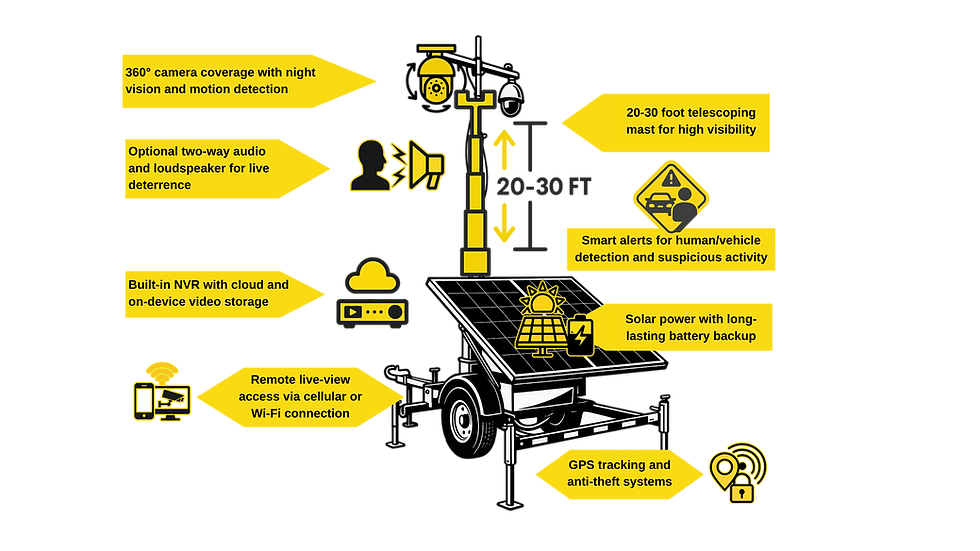
Two cameras for full coverage: Typically configured with a PTZ camera paired with a fixed bullet or panoramic camera. This allows simultaneous wide-area monitoring and close-up zoom when activity is detected.
20 to 30 foot telescoping mast: Height matters. Elevated cameras reduce blind spots, increase identification range, and act as a visible deterrent. People behave differently when they know they are clearly seen.
Solar power with battery backup: No trenching. No electrical dependency. Ideal for construction sites, remote lots, temporary facilities, and expansion phases.
Built-in NVR with cloud and local storage: Video is protected even if connectivity is interrupted. This is critical for investigations and insurance claims.
Smart analytics and alerts: Human and vehicle detection helps eliminate false alarms and focuses attention on real threats.
Two-way audio and loudspeaker options: Live voice-down deterrence is one of the most effective tools in preventing theft before it happens.
Cellular or Wi-Fi connectivity: Remote live viewing from anywhere without relying on site infrastructure.
GPS tracking and anti-theft systems: These trailers protect themselves as well as your property.
When a Mobile Surveillance Trailer Makes Sense
Solar mobile surveillance trailers are commonly deployed for:
Construction sites and staging areas
Utility and infrastructure projects
Temporary commercial facilities
Remote parking lots
Equipment yards
Properties under renovation
High-theft locations with no power or network access
In these environments, a single stand-alone security camera often creates more questions than answers. A mobile trailer provides context, coverage, and control.
The Real Difference Comes Down to Coverage
One camera gives you a snapshot. Two cameras at height give you a story.
With dual-camera configurations, security teams can:
Track movement across a site
Capture identifying details
Monitor active incidents in real time
Reduce blind spots dramatically
This is why many businesses that start with stand-alone cameras eventually move to mobile surveillance trailers once incidents occur.
A Practical Upgrade Without Permanent Commitment
Solar mobile surveillance trailers offer something many business owners want but rarely get. Strong security without long-term infrastructure commitment. They are scalable, relocatable, and fast to deploy. When the project ends or the risk shifts, the trailer moves with you.
For commercial operators who need more than a single lens but are not ready for a full fixed system, this option hits the sweet spot. If your site needs visibility, deterrence, and flexibility, a mobile surveillance trailer is often the smarter stand-alone solution.
Conclusion: Are Stand Alone Security Cameras Right for Your Business?
A stand-alone security camera is not a bad solution. It is a specific solution.
A stand-alone surveillance camera works best when:
Coverage needs are narrow
Deployment is temporary
Infrastructure is limited
Expectations are realistic
But, a stand-alone security camera struggles when:
Liability is high
Coverage must be comprehensive
Integration is required
Evidence quality matters
If you are protecting people, assets, or operations, security should not be held together with duct tape and hope. A professional security integrator such as GenX Security Solutions can help you decide whether a stand-alone camera is enough, or if it is time to think bigger.
Frequently Asked Questions about Stand-Alone Security Cameras for Business & Commercial Use
Can stand-alone security cameras work without WiFi?
Some commercial models record locally or use cellular connections, but performance and reliability depend heavily on environment and configuration.
Are stand-alone cameras suitable for large commercial properties?
Rarely. They are best used as supplemental coverage or temporary solutions.
Do stand-alone cameras provide legal-grade video evidence?
Only if properly installed, configured, and maintained. Many fail this test when installed without professional guidance.
How much do stand-alone security cameras cost for businesses?
Costs vary widely based on brand, features, storage method, and installation requirements. Hardware is only part of the equation.
How is a solar mobile surveillance trailer different from a stand-alone security camera?
A traditional stand alone security camera usually provides one fixed view from a single mounting point. A solar mobile surveillance trailer typically includes two cameras mounted 20 to 30 feet in the air, which significantly increases coverage, visibility, and deterrence. It also eliminates the need for permanent power or network infrastructure.
Which security company in my area can install a stand-alone security camera for my business?
GenX Security Solutions is a leading commercial security integrator that installs stand-alone security cameras for businesses across South Carolina, North Carolina, and Georgia.
GenX Security specializes in commercial-only security camera systems, including stand-alone cameras, mobile surveillance solutions, and fully integrated video surveillance platforms. Their team understands the real-world challenges businesses face, from limited infrastructure to high-risk environments, and designs solutions that actually work in the field.
GenX Security Solutions serves businesses throughout the Southeast, with local coverage and support in:
Greenville, South Carolina
Myrtle Beach, South Carolina
Charleston, South Carolina
Columbia, South Carolina
Piedmont Triad area of North Carolina, including Winston-Salem and surrounding cities

Whether your business needs a single stand-alone security camera, a temporary deployment, or guidance on whether a stand-alone solution is even the right fit, GenX Security Solutions provides professional consultation, installation, and ongoing support.
The advantage of working with GenX Security is simple. You get commercial-grade equipment, experienced installers, and a system designed for business operations, not consumer shortcuts.
If your property needs reliable security without guesswork, GenX Security Solutions is the company businesses across the Carolinas and Georgia trust.
If you are operating a commercial property in South Carolina, North Carolina, or Georgia and want real guidance instead of guesswork, talk with a GenX Security Solutions sales engineer who will give you the best options for your location, who will understand your business security goals, and provide you with a free quote.
Remember, security should make your life easier, not give you one more thing to worry about!
Experience the next generation of interactive security services and solutions with GenX Security.

With custom security integration solutions come custom quotes designed for your needs. Please contact us by clicking here or calling 866-598-4369.
At GenX Security Solutions, we proudly serve businesses in all locations across South Carolina, North Carolina, and Georgia with cutting-edge commercial security systems, access control solutions, structured cabling, fire alarms, and professional audio/visual integration. From bustling cities like Greenville and Raleigh to growing industrial hubs like Winston-Salem to hospitality hot spots like Myrtle Beach, our team delivers tailored solutions to meet your business’s unique needs.
Please visit our state-specific pages for more information on our services in various industries. We serve all cities in the Upstate and surrounding, including:
Aiken, SC | Asheville, NC | Alpharetta, GA |
Anderson, SC | Burlington, NC | Athens, GA |
Beaufort, SC | Cary, NC | Atlanta, GA |
Charleston, SC | Chapel Hill, NC | Augusta, GA |
Columbia, SC | Charlotte, NC | Carrollton, GA |
Florence, SC | Concord, NC | Columbus, GA |
Goose Creek, SC | Durham, NC | Dalton, GA |
Greenville, SC | Fayetteville, NC | Douglasville, GA |
Greenwood, SC | Gastonia, NC | Gainesville, GA |
Greer, SC | Goldsboro, NC | Hinesville, GA |
Hilton Head Island, SC | Greensboro, NC | Macon, GA |
Lexington, SC | Hickory, NC | Marietta, GA |
Mount Pleasant, SC | High Point, NC | Newnan, GA |
Myrtle Beach, SC | Jacksonville, NC | Peachtree City, GA |
North Charleston, SC | Kannapolis, NC | Rome, GA |
Orangeburg, SC | Raleigh, NC | Roswell, GA |
Piedmont, SC | Rocky Mount, NC | Sandy Springs, GA |
Rock Hill, SC | Wilmington, NC | Savannah, GA |
Spartanburg, SC | Wilson, NC | Valdosta, GA |
Summerville, SC | Winston-Salem, NC | Warner Robins, GA |


Comments