


![2020 Roaring Twenties Winner Badge[44136].jpg](https://static.wixstatic.com/media/c44162_312513fcb3514e3ca71a2a18b458369a~mv2.jpg/v1/fill/w_129,h_52,al_c,q_80,usm_0.66_1.00_0.01,enc_avif,quality_auto/2020%20Roaring%20Twenties%20Winner%20Badge%5B44136%5D.jpg)


Rolling Blackouts Are Here. Is Your Facility Security System Ready?
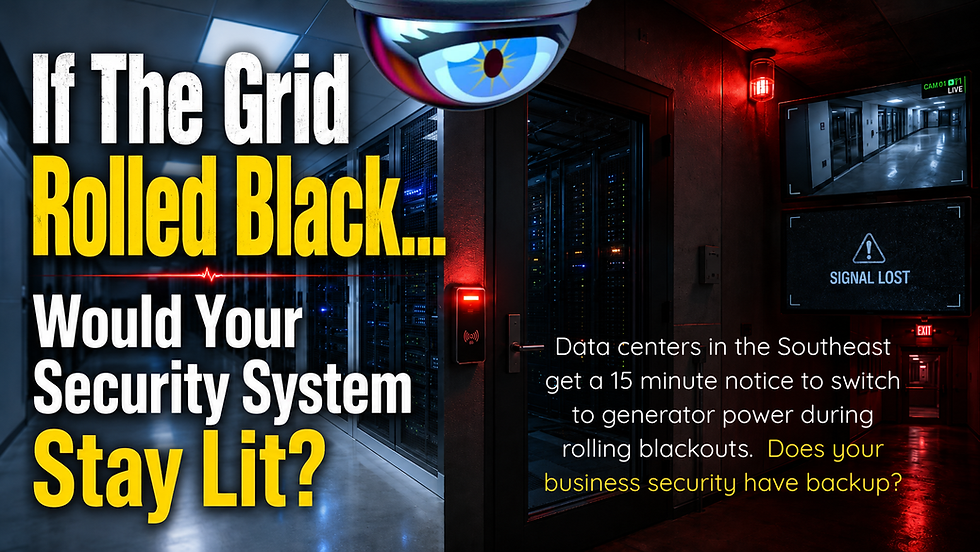
GenX Security Solutions has designed and installed commercial security systems for data centers, manufacturers, and businesses across South Carolina, North Carolina, and Georgia since 2003. Ranked 23rd in 2023, 14th in 2024, and 14th in 2025 on the SC Top 50 Fastest-Growing Companies list, with 2,000+ completed projects, GenX Security Solutions designs power-resilient security systems that stay active when the grid does not.
Quick Answer: Keeping Security Technology Active During Power Outages |
When a DOE Section 202(c) emergency order forces a data center or commercial facility off the utility grid, fail-safe access control doors unlock within seconds, cameras go blind, and intrusion detection loses communication only properly sized UPS, generator integration, and fail-secure hardware keep critical areas protected during rolling blackouts. On July 2, 2026, the U.S. Department of Energy issued an emergency order authorizing Duke Energy Carolinas and Duke Energy Progress to operate at maximum generation output to prevent blackouts across the Carolinas amid record heat. This is the third time in 2026 the DOE has invoked Section 202(c) of the Federal Power Act, a 1935 wartime statute, to manage grid stress caused by AI data center load growth. When that order was signed, every facility in the Duke Energy territory with fail-safe access control had doors that would unlock at the moment of a power event. Every facility without a UPS had cameras that would go dark. GenX Security Solutions designs integrated, power-resilient security systems for data centers and commercial facilities across SC, NC, and GA. Call 866-598-4369 for a free assessment. |
The summer of 2026 has made one thing clear: the power grid in the Southeast is operating at the edge of its capacity, and the federal government is using emergency law to keep it from falling over.
On July 2, PJM Interconnection, the 13-state regional grid that includes North Carolina, recorded approximately 163 gigawatts of demand, one of the highest load days in nearly a century of operation. Duke Energy's service territory across the Carolinas faced heat index values above 105°F. The DOE had already invoked the same emergency authority twice earlier in 2026. Data centers are now projected to add 65 gigawatts of new demand to the PJM grid over the next decade which is more than the entire generation capacity of most states.

The grid problem and the security problem are the same problem. When power becomes unreliable, the facilities that depend on electronic security systems face a second, immediate risk: the systems designed to protect them stop working.
What Did the Federal Government Actually Order for Data Centers?
Section 202(c) of the Federal Power Act gives the Secretary of Energy authority to compel grid operators to take emergency action during a supply crisis. The law was written in 1935 for wartime. The DOE has now used it three times in six months, all for the same reason: AI data centers have added load to the grid faster than generation and transmission infrastructure can follow.
The June 30, 2026 order covering the PJM grid required AI data centers with at least 50 megawatts of peak load to switch to their own diesel backup generators within 15 minutes of an emergency signal. The July 2 order for Duke Energy Carolinas authorized the utility to run all generation units at maximum output beyond normal environmental permit limits to prevent rolling blackouts across SC and NC through July 6.
NERC, the North American Electric Reliability Corporation, issued a Level 3 Alert in 2026, its highest severity designation and rarely used, identifying data center load as an immediate risk to grid reliability.
15 minutes to switch to backup generators is not a plan. It is a warning.
What Happens to Security Systems When Power Drops?
Most facilities do not lose power cleanly. The transition from utility power to backup generation, even with a properly functioning UPS, creates a brief interruption window. During that window, and for as long as backup power is unavailable or undersized, security systems behave in ways most facility managers do not expect until it happens.
Security System Behavior During Power Loss
Security System Component | Without Backup Power | With Properly Sized UPS | With Generator Integration |
Access control (fail-safe doors) | Unlocks immediately | Stays locked through UPS runtime | Stays locked indefinitely |
Access control (fail-secure doors) | Stays locked; requires mechanical egress | Stays locked and electronically functional | Stays locked indefinitely |
Stops recording within seconds | Records through UPS runtime (30 min to 4+ hrs) | Records indefinitely | |
Loses communication; may alert | Stays on panel battery + UPS | Stays fully functional | |
Switches to internal battery (24-72 hr code minimum) | No additional benefit needed; already battery-backed | No change | |
Goes dark | Protected through UPS runtime | Stays functional |
The fire alarm is the only common security system that carries a mandatory battery backup by code. Everything else (access control, cameras, intrusion detection, AV) depends on what the integrator designed and what the facility owner approved.

Real Integrator Answers to Real Questions About Blackouts and Facility Security
At GenX Security Solutions we deal with the toughest security questions directly and honestly, from facility managers, security directors, IT managers, and facilities teams. When it comes to rolling blackouts, maintaining security is a big concern but doesn't have to be if planned right from the start.
"Our data center access control doors are set to fail-safe. Should we change them to fail-secure given rolling blackout risk?"
Yes — with important distinctions. Egress paths, fire exits, and stairwells must remain fail-safe by fire code. But any door protecting a server room, UPS room, data closet, or controlled access area should be fail-secure. A rolling blackout that unlocks your server room while cameras are dark is a breach event with no evidence trail.
"During last summer's heat wave the power flickered and all our mag locks released. Is that normal? Can it be fixed?"
That is exactly how maglocks behave without battery backup or UPS protection on the door controller. The fix is a UPS on the access control panel and, for high-risk doors, conversion to fail-secure hardware (electric strike or motorized deadbolt). GenX Security Solutions audits and redesigns access control systems across SC, NC, and GA.
"Our UPS only covers about 20 minutes. If the DOE orders Duke Energy to shed load, what happens to our cameras during the switchover?"
If your generator starts within 20 minutes and your ATS is functioning then your cameras stay up. If startup takes longer or the ATS fails, the NVR loses power and recording stops. Gaps in NVR footage during a grid event are the most common evidence problem GenX Security Solutions sees in post-incident reviews. The solution is a larger UPS runtime buffer and a monthly generator test protocol.
"Power went out for 2 hours during the heat dome. My NVR stopped after 45 minutes. What UPS do I actually need?"
Runtime depends on the number of cameras and the NVR's power draw. A mid-range UPS (3000VA, ~2000W capacity) typically supports a 16-camera IP system for 2 to 4 hours. For longer coverage, a UPS paired with a generator and ATS is the only reliable solution. GenX Security Solutions sizes and installs UPS-generator integrated systems for commercial facilities across the region.
"What happens to a commercial intrusion alarm system when power goes out for 3+ hours? Does it call the monitoring center?"
Most commercial intrusion panels carry a built-in battery that lasts 4 to 24 hours depending on panel size and attached devices. During that window, the system stays armed and communicates over cellular backup if the internet is also down. After battery depletion, the system goes into low-power mode and may stop communicating. GenX Security Solutions installs intrusion systems with cellular redundancy for exactly this scenario.
"Is there a standard for how long a data center's access control system should run on backup power?"
ANSI/BHMA A156.25 covers access control hardware, but there is no single federal standard for backup power duration in access control. Uptime Institute Tier Standards recommend N+1 or 2N redundancy for data center power overall. For security systems specifically, the practical standard is: access control should stay active for the full duration the facility expects to run on generator power, typically 72 hours minimum for Tier 3 facilities. GenX Security Solutions designs access control power systems to match each facility's generator runtime target.
The Fail-Safe vs. Fail-Secure Decision Has Never Mattered More During Forced Power Outages
This is the most critical hardware decision in any security system, and the one most often set incorrectly for the threat environment.
A fail-safe lock requires continuous power to stay locked. Lose power from a grid event, a breaker trip, or a deliberate cut and the door opens. Magnetic locks (maglocks) are the most common fail-safe hardware. Fire code requires egress paths to be fail-safe, which is correct: people must be able to exit a building during a fire or emergency.
A fail-secure lock stays locked when power is lost. Electric strikes and motorized deadbolts are the most common fail-secure hardware. Fail-secure locks must always include a mechanical egress option on the inside to prevent occupant entrapment.
The rule of thumb that governs every door in a data center or commercial facility:
Egress paths, stairwells, exterior fire exits: fail-safe (code-required)
Server rooms, data closets, UPS rooms, IT equipment areas, evidence storage, pharmaceutical storage, executive areas: fail-secure
Loading docks and shipping access: fail-secure with video verification integration
A fail-safe lock on a server room fails your security at exactly the moment you need it most.
During a rolling blackout, the combination of unlocked server room doors and dark cameras creates a window for unauthorized access that is difficult to document, difficult to prosecute, and impossible to reverse. GenX Security Solutions audits access control hardware configurations for data centers and commercial facilities across SC, NC, and GA. The access control platforms GenX Security Solutions installs, including LenelS2, Gallagher, and Brivo, all support fail-secure configurations with battery-backed controllers.
How Long Does Backup Power Actually Last?
Backup power is a layered system, not a single device. For any facility that cannot afford a gap in security coverage, understanding what each layer does and how long it lasts is the starting point for a real continuity plan.
Backup Power Runtime by System
Backup Solution | What It Covers | Typical Runtime |
Built-in panel battery (access control) | Controller and readers | 4 to 8 hours |
Small UPS (1500VA) | NVR + 4-8 cameras | 30 to 90 minutes |
Mid-range UPS (3000VA+) | NVR + 16+ cameras, access control panel | 2 to 6 hours |
Large UPS / battery cabinet | Full security system room | 4 to 12 hours |
Diesel generator (with ATS) | Entire facility | Fuel-dependent; 72+ hours typical with full tank |
Natural gas generator | Entire facility | Continuous with connected supply |
The automatic transfer switch (ATS) is what converts a generator from a piece of equipment into a continuity solution. Without an ATS, backup generator power requires manual connection and during a grid emergency, that delay can be measured in minutes while doors are unlocked and cameras are off. GenX Security Solutions designs and installs ATS-integrated generator systems for commercial facilities across the region.
For data centers operating under a DOE Section 202(c) order, the 15-minute switchover window assumes a functioning ATS, a properly sized and fueled generator, and a tested startup sequence. For businesses in the Duke Energy territory that did not receive that 15-minute warning, the window was zero.
What This Means for Businesses That Are Not Data Centers
The DOE orders apply specifically to facilities with 50 megawatts or more of peak load: data centers, large industrial facilities, and similar large consumers. A commercial office building, a manufacturing plant, or a healthcare clinic is not covered by these orders. But it is on the same grid.

When Duke Energy runs its generators at maximum output to prevent rolling blackouts across the Carolinas, smaller commercial facilities experience the same voltage fluctuations, the same brief outage events during load switching, and the same summer peak demand risk that the emergency orders were designed to address.
Data centers got 15 minutes notice. Most commercial buildings got none.
For any business where video surveillance, access control, intrusion detection, fire alarm, or structured AV is critical to daily operations or life safety, the question is not whether a power event will affect the security system. The question is whether the system was designed to stay active when it does.
Related post: For a deeper look at how GenX Security Solutions designs integrated, energy-efficient security infrastructure for data centers specifically, see our guide to energy-efficient security systems, structured cabling, and AV for data centers in the Southeast.
GenX Security Solutions has designed power-resilient commercial security systems for data centers, manufacturers, healthcare facilities, and businesses across SC, NC, and GA since 2003. Ranked 23rd, 14th, and 14th on the SC Top 50 Fastest-Growing Companies list three consecutive years, GenX Security Solutions is the integrator Southeast facilities call when security systems have to work, including when the grid does not.
Contact GenX Security Solutions at 866-598-4369 or visit genxsecurity.com. We service South Carolina, North Carolina, and Georgia from our offices in Piedmont/Greenville SC, Charleston SC, Columbia SC, Myrtle Beach SC, and the Piedmont Triad NC.

Frequently Asked Questions: Security Systems and Rolling Blackouts
What happens to access control when power goes out during a rolling blackout?
Access control systems switch to battery backup in the control panel when utility power is lost. Most commercial panels support 4 to 8 hours of battery runtime for the controller and readers. However, the door hardware itself determines what happens to the door: fail-safe locks (including most maglocks) unlock immediately when power is lost, while fail-secure locks (electric strikes, motorized deadbolts) stay locked. Data centers and secure commercial facilities in SC, NC, and GA should audit their door hardware configurations before the next grid stress event.
Do security cameras keep recording during a rolling blackout?
Security cameras and NVR/DVR recorders require continuous power to operate. Without a UPS or generator connection, cameras stop recording within seconds of a power loss. A properly sized UPS provides 30 minutes to 4+ hours of runtime depending on system size. For extended coverage, a UPS paired with an automatic transfer switch and generator is the only reliable solution. GenX Security Solutions designs and installs UPS-generator integrated camera systems for commercial clients across SC, NC, and GA.
What is the DOE Section 202(c) emergency order and does it affect my business?
Section 202(c) of the Federal Power Act gives the U.S. Secretary of Energy authority to compel grid operators and utilities to take emergency action during supply crises. The DOE issued a Section 202(c) order on July 2, 2026 specifically for Duke Energy Carolinas and Duke Energy Progress, authorizing maximum generation output to prevent blackouts across SC and NC through July 6. The order applies directly to facilities with 50+ MW of peak load, primarily data centers. However, any business in the Duke Energy territory is on the same grid and subject to the same summer peak demand conditions.
What is the difference between fail-safe and fail-secure access control, and which does my facility need?
A fail-safe lock requires power to stay locked and unlocks when power is lost. A fail-secure lock stays locked when power is lost and requires a mechanical override for egress. Egress paths and fire exits must be fail-safe by fire code. Server rooms, data closets, IT equipment rooms, evidence storage, and other high-security areas should use fail-secure hardware. During a rolling blackout, a fail-safe server room door creates an unauthorized access window with no camera coverage, the most dangerous combination of failure modes a facility can have.
How long should a UPS power a commercial security system?
A small UPS (1500VA) powers a basic NVR and 4 to 8 cameras for 30 to 90 minutes. A mid-range UPS (3000VA+) supports a 16+ camera system for 2 to 6 hours. For full-facility coverage during extended outages, a generator with an automatic transfer switch is required. GenX Security Solutions sizes UPS and generator solutions for commercial security systems based on each facility's camera count, access control panel load, and required runtime duration.
Which office does GenX Security Solutions serve for data center security in South Carolina and North Carolina?
GenX Security Solutions serves data centers and commercial facilities from offices in Greenville, SC (headquarters), Charleston, SC, Columbia, SC, Myrtle Beach, SC, and the Piedmont Triad, NC. The Greenville office serves the Upstate SC and Western NC data center corridor, including facilities in the Charlotte, Spartanburg, and Greenville metro areas. Call 866-598-4369 to schedule a free power-resilience assessment for your security system.
Experience the next generation of interactive security services and solutions with GenX Security.

With custom security integration solutions come custom quotes designed for your needs. Please contact us by clicking here or calling 866-598-4369.
At GenX Security Solutions, we proudly serve businesses in all locations across South Carolina, North Carolina, and Georgia with cutting-edge commercial security systems, access control solutions, structured cabling, fire alarms, and professional audio/visual integration. From bustling cities like Greenville and Raleigh to growing industrial hubs like Winston-Salem to hospitality hot spots like Myrtle Beach, our team delivers tailored solutions to meet your business’s unique needs.
Please visit our state-specific pages for more information on our services in various industries. We serve all cities in the Upstate and surrounding, including:
Aiken, SC | Asheville, NC | Alpharetta, GA |
Anderson, SC | Burlington, NC | Athens, GA |
Beaufort, SC | Cary, NC | Atlanta, GA |
Charleston, SC | Chapel Hill, NC | Augusta, GA |
Columbia, SC | Charlotte, NC | Carrollton, GA |
Florence, SC | Concord, NC | Columbus, GA |
Goose Creek, SC | Durham, NC | Dalton, GA |
Greenville, SC | Fayetteville, NC | Douglasville, GA |
Greenwood, SC | Gastonia, NC | Gainesville, GA |
Greer, SC | Goldsboro, NC | Hinesville, GA |
Hilton Head Island, SC | Greensboro, NC | Macon, GA |
Lexington, SC | Hickory, NC | Marietta, GA |
Mount Pleasant, SC | High Point, NC | Newnan, GA |
Myrtle Beach, SC | Jacksonville, NC | Peachtree City, GA |
North Charleston, SC | Kannapolis, NC | Rome, GA |
Orangeburg, SC | Raleigh, NC | Roswell, GA |
Piedmont, SC | Rocky Mount, NC | Sandy Springs, GA |
Rock Hill, SC | Wilmington, NC | Savannah, GA |
Spartanburg, SC | Wilson, NC | Valdosta, GA |
Summerville, SC | Winston-Salem, NC | Warner Robins, GA |


Comments