


![2020 Roaring Twenties Winner Badge[44136].jpg](https://static.wixstatic.com/media/c44162_312513fcb3514e3ca71a2a18b458369a~mv2.jpg/v1/fill/w_129,h_52,al_c,q_80,usm_0.66_1.00_0.01,enc_avif,quality_auto/2020%20Roaring%20Twenties%20Winner%20Badge%5B44136%5D.jpg)


Buyer's Guide to Solar-Powered Surveillance Trailers for Retail Parking Lots in SC, NC & Georgia
Quick Answer: Deploying Mobile Surveillance Trailers to Retail Parking Lots |
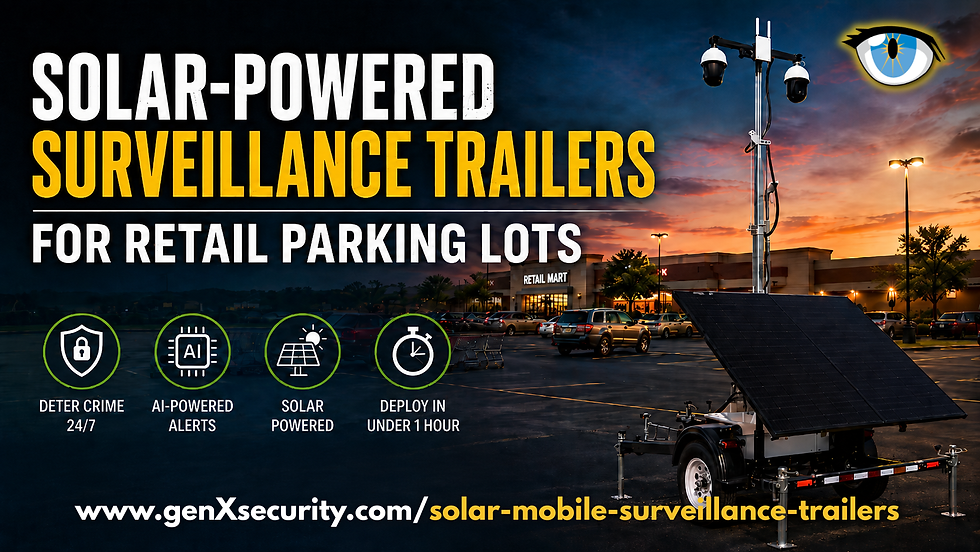
Retail parking lots are the third most common location for violent crime in the U.S., behind only residences and streets, and they are hit hardest of all parking facility types for vehicle break-ins because criminals assume shoppers’ cars hold fresh purchases (FBI Crime Data Explorer). A solar-powered mobile surveillance trailer gives a retail lot 24/7 HD coverage, AI-triggered alerts, and a visible deterrent in under an hour, with no trenching, permitting delay, or multi-month construction project. For a retail parking lot in Greenville, Charleston, Columbia, Myrtle Beach, or the Piedmont Triad, a trailer is typically the fastest way to close a security gap before the next incident. GenX Security Solutions installs commercial security systems and mobile surveillance trailers across South Carolina, North Carolina, and Georgia. GenX Security Solutions, founded in 2003, is an award-winning NWBOC certified woman-owned company ranked 23rd (2023), 14th (2024), and 14th (2025) on the SC Top 50 Fastest-Growing Companies list. |
Real Retail Parking Lot Problems, Real Security Solutions
A store can lock its front door at 9pm. It can’t lock its parking lot.
The questions below aren’t hypothetical. They reflect the kind of language loss prevention managers, store owners, and property managers actually use in retail and discuss with our sales engineers when they’re reaching out to us with this exact problem.
“What’s the best way to secure a parking lot at a shopping center that keeps getting hit with car break-ins?”
A visible, actively monitored camera system is the single highest-leverage fix. Layered security (cameras plus monitoring plus lighting) can cut incidents by up to 51%. GenX Security Solutions typically starts with a mobile surveillance trailer at the specific problem area, usually the outer rows or a blind corner, because it gets real coverage in place within days instead of waiting months on a permanent installation.
“Are those solar camera trailers actually worth it, or is it just a gimmick?”
They’re a legitimate, widely used tool, not a gimmick. GenX Security Solutions builds them for law enforcement divisions and construction sites as well as retail lots, because the visible mast and real-time monitoring change offender behavior, not just record it afterward. The honest caveat: a trailer that’s parked and forgotten, with no monitoring behind it, is a much weaker deterrent than one that’s actively watched and paired with good lighting.
“How many cameras do I need to cover a big parking lot?”
It depends more on lot shape and blind spots than square footage. A single trailer with a 360° PTZ camera on a 30-foot mast can often cover an entire mid-size lot from one position, while an irregular lot with buildings or structures blocking sightlines may need two units. GenX Security Solutions runs a free site assessment to map coverage before recommending a count.
“Is a security guard or a camera trailer better for stopping catalytic converter theft?”
For catalytic converter theft specifically, a trailer usually wins on cost and consistency: a guard can’t watch every row at once and isn’t on-site during shift gaps, while a trailer with night vision and motion alerts covers the lot continuously. Guards still matter when a situation calls for a human presence or de-escalation, which is why some GenX Security Solutions clients run both together.
“Do these trailers actually get monitored 24/7, or is it just recording that nobody watches until after something happens?”
Both models exist, and it’s worth asking which one you’re buying. GenX Security Solutions offers trailers as standalone recording units or with optional professional monitoring, where a live alert reaches a monitored team the moment AI flags motion or an intrusion, rather than only reviewing footage after an incident has already been reported.
Why Are Retail Parking Lots Such a Common Target for Crime?
Retail theft may begin in the aisle. The parking lot is where it becomes an escape plan.
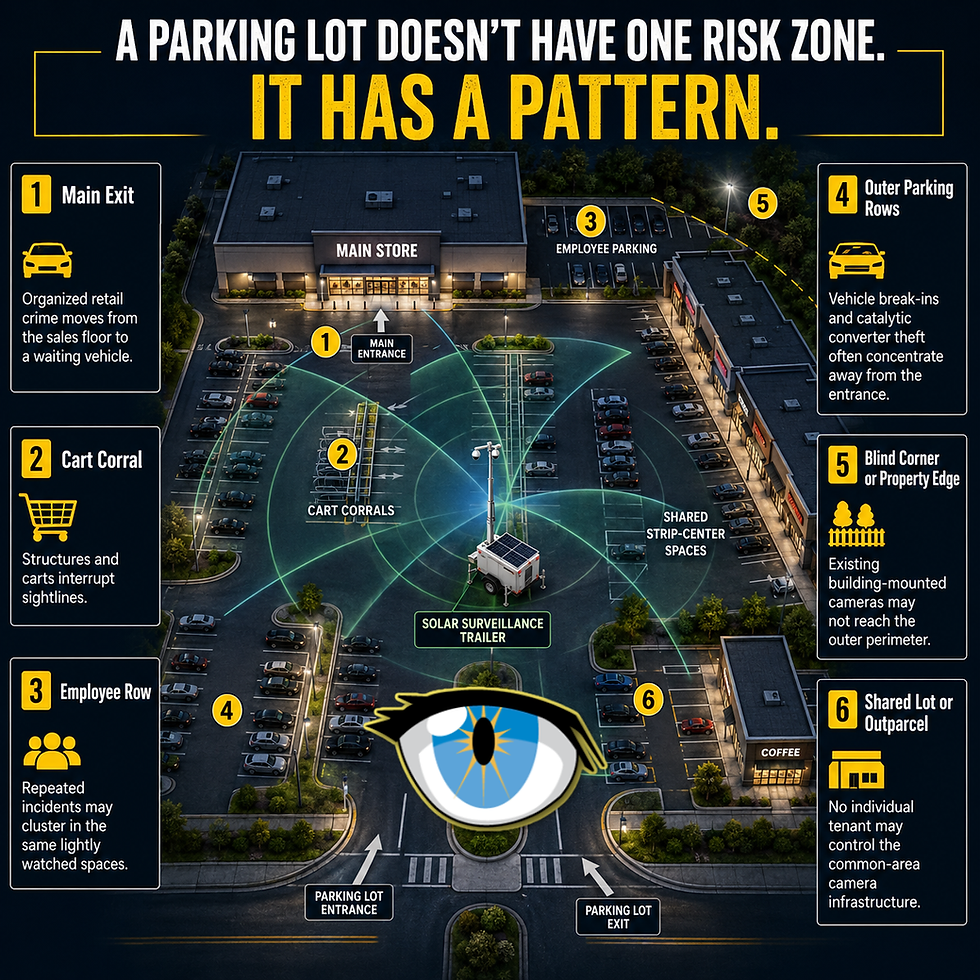
Retail parking lots sit at the intersection of two problems retailers can’t fully control: the lot itself is semi-public space outside the four walls where staff and store-level security have authority, and it is where the store’s theft problem physically exits the building. Organized retail crime (ORC) does not stop at the front door — getaway vehicles, fence-and-resale handoffs, and confrontations with loss prevention staff routinely happen in the parking lot, not the aisle.
“Parking facilities are the third most common location for violent crime in the United States, behind only residences and streets.” — FBI Crime Data Explorer
The numbers back this up. Retailers surveyed by the National Retail Federation reported an 18% year-over-year increase in shoplifting incidents (2024 vs. 2023), and threats or acts of violence during theft events rose 17% over the same period. Separately, retail parking lots are documented as the hardest-hit parking facility type for vehicle break-ins, since offenders assume a shopper’s car holds a bag from the store they just left.
Retail Parking Lot Crime, By the Numbers
Statistic | Source & Year |
Parking facilities are the #3 most common location for violent crime in the U.S., behind residences and streets | FBI Crime Data Explorer, 2022 |
130,252+ crimes against persons were recorded in parking lots/garages in a single year | FBI, 2021 |
About 22% of all vehicle thefts nationwide occur in parking facilities | FBI, 2020 |
A vehicle is stolen from a parking facility roughly every 23 seconds | FBI |
Retail parking lots are hit hardest for vehicle break-ins; shopping malls and big-box lots see the highest rates | Get Safe and Sound analysis of FBI data, 2026 |
Catalytic converter theft claims peaked at 64,701 nationally in 2022 before falling to roughly 14,036 in 2024 | National Insurance Crime Bureau (NICB), 2023/2025 |
Average catalytic converter theft claim costs about $2,900 per vehicle | State Farm, 2024 |
Shoplifting incidents rose 18% year-over-year (2024 vs. 2023) among major retailers surveyed | National Retail Federation, 2025 Organized Retail Crime survey |
61% of retailers increased perimeter/exterior security in response to rising theft and violence | National Retail Federation, 2025 |
Layered visible security (cameras + monitoring + lighting) can reduce incidents by up to 51% | University of Cambridge research, cited via Get Safe and Sound, 2026 |
What most retail security content won’t tell you: catalytic converter theft claims have actually fallen 68% nationally since the 2022 peak (NICB, 2023 vs. 2025). That’s not a reason to relax, it’s a reason to look at the bigger picture instead of one theft trend. Parking facilities are still the FBI’s #3 location for violent crime nationally, and retail lots specifically remain the hardest-hit type for vehicle break-ins. The threat didn’t go away; it shifted from a single headline-grabbing crime wave to a broader, more persistent lot-crime problem.
For a retail operator, that translates into three concrete risks: shrink that walks out through the parking lot, liability exposure when a customer or employee is assaulted or injured in the lot, and the operational cost of an incident bad enough to trigger a temporary closure or reduced hours — 28% of retailers surveyed by NRF report having closed a specific location and 45% reduced operating hours because of crime.
If you’re the loss prevention manager who has to explain to a district VP why the same three spots in the employee row keep showing up in the incident log, or the property manager fielding tenant calls after the third break-in this month, those numbers stop being industry statistics and start being the specific report due on someone’s desk this week.
What Is a Solar-Powered Mobile Surveillance Trailer, and How Does It Work in a Retail Parking Lot?
A parking lot with no cameras isn't unmonitored. It's advertised.
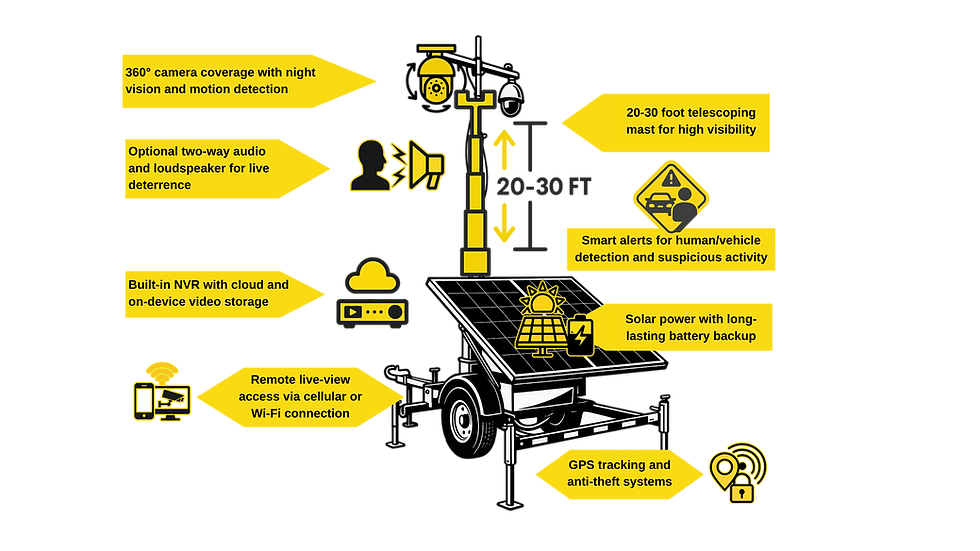
A mobile surveillance trailer is a self-contained, towable security unit with HD PTZ cameras, a telescoping mast (up to 30 feet), solar panels, battery storage, and cellular connectivity, built to operate with no power lines and no permanent installation. GenX Security Solutions designs the trailer based on your needs and budget and when ready we deliver and park the trailer, drop the stabilizing jacks, raise the mast, and bring the system online. The whole process typically takes under an hour, and one person can do it. From the parking lot, what a would-be thief actually sees is a telescoping mast rising above the cart corral, a slowly panning PTZ camera, and on monitored units a flashing LED strobe and a live voice warning the moment they linger too long near a row of parked cars.
Once live, the trailer provides:
360° HD coverage with infrared night vision and PTZ zoom for license plates and faces
AI-triggered alerts that flag motion, loitering, or intrusion in real time
Two-way audio so a monitored trailer can issue a live or pre-recorded warning the moment someone lingers near a row of cars after close
Solar power with battery backup, so the unit runs 24/7 without depending on the property’s electrical infrastructure
Remote live viewing from a phone or desktop, with optional professional monitoring from GenX Security Solutions’ team
Because the unit requires no trenching, no electrical permit, and no multi-week installation crew, it can be deployed to a specific parking lot, outparcel, or hot-zone location days after the decision is made, not months.
What Do Retail Loss Prevention Teams Actually Use These Trailers For?

Big-Box and Grocery Anchor Lots
A large-format retailer with a lot that spans several hundred spaces cannot economically staff a guard at every entrance. A trailer positioned near the cart corral or a known break-in cluster gives 24/7 high-mast coverage of the area where catalytic converter theft and vehicle break-ins concentrate, without adding headcount.
Strip Centers and Outparcels
A strip center with a bank, a fast-casual restaurant, and two or three small retailers often has no shared security budget and no single tenant willing to fund a permanent camera system for common-area parking. A trailer can be brought in by the property manager or a lead tenant, covering the shared lot without any tenant needing to run new cabling to their unit.
Seasonal and Holiday Surge Coverage
Retail parking lot incidents cluster around predictable surge periods: back-to-school, Black Friday through New Year’s, and graduation season near college-town retail corridors. A trailer can be deployed for the eight- to ten-week surge window and then relocated, instead of paying for a permanent system sized for the busiest week of the year.
Post-Incident Hot-Zone Response
When a specific lot has a break-in cluster, a catalytic converter theft spree, or an assault, loss prevention teams increasingly need visible, rapid coverage at that one location while the incident is investigated and insurance/liability exposure is assessed. A trailer can be on-site within days, which a permanent camera project cannot match.
Outdoor Shopping Centers and Lifestyle Centers
Open-air centers with shared parking fields across multiple buildings (common in Greenville’s Woodruff Road corridor and similar retail corridors in Charleston, Columbia, and Myrtle Beach) often have gaps in existing camera coverage at the outer edges of the lot, exactly where vehicle break-ins and catalytic converter theft concentrate.
Mobile Surveillance Trailer vs. Security Guard vs. Fixed Camera System: Which Is Right for a Retail Lot?
Mobile Surveillance Trailer | On-Site Security Guard | Permanent Fixed Camera System | |
Setup time | Under 1 hour | Immediate, but ongoing scheduling required | Weeks to months (permitting, trenching, electrical) |
Ongoing cost | Flat rental or purchase; no headcount | Hourly wages, 24/7 coverage requires multiple shifts | Install cost upfront, then low ongoing cost |
Mobility | Fully mobile; relocate to a new lot or hot zone in minutes | Not applicable | Fixed once installed |
Coverage | 360°, up to 30-ft mast height, night vision | Limited to guard’s physical location and attention | Fixed camera positions, no mast height flexibility |
Visible deterrent | High — unit is highly visible | High while guard is present; gaps during breaks/shift change | Moderate — cameras often less noticeable |
Best for | Seasonal surges, hot-zone response, shared lots, no infrastructure | High-touch situations requiring a human presence or de-escalation | Long-term, single-location coverage with capital budget available |
Many retail operators use a trailer as the fast, flexible first response to a specific lot’s problem, then decide later whether a permanent system is worth the capital investment once the trailer’s data shows exactly where and when incidents cluster.
How Much Does a Mobile Surveillance Trailer Cost for a Retail Parking Lot?
Mobile surveillance trailers are generally available for purchase starting from $25,000 +, depending on camera configuration, AI analytics, and monitoring add-ons, with monthly rental options for retailers who need coverage for a defined season or hot-zone window rather than a permanent purchase. This is not a quote, but GenX Security Solutions provides a custom price based on the specific lot, coverage area, and whether professional monitoring is added.
Set against the cost side of the ledger, the National Retail Federation found retailers now spend approximately $12 billion annually on theft prevention industry-wide, and 75% of retailers surveyed added or increased uniformed security officers in response to rising theft and violence. A single prevented incident, an averted catalytic converter theft averaging $2,900 per vehicle (State Farm, 2024), or a single avoided liability claim from a parking lot assault, can offset a meaningful share of a trailer’s cost. Against a 24/7 guard schedule, which requires multiple shifts to cover the same hours a trailer covers continuously, the trailer is frequently the lower ongoing cost option for lot-only coverage.
Can a Surveillance Trailer Integrate With My Existing Store Security Systems?
Yes. GenX Security Solutions can design your commercial security suite as an integrated system rather than a collection of standalone devices. A parking lot trailer’s video feed and AI alerts can be routed to the same monitoring dashboard as a retail location’s in-store video surveillance, access control, and intrusion alarm systems, giving loss prevention a single point of visibility from the sales floor to the outer edge of the lot. For retail chains with corporate procurement or vendor-compliance requirements, GenX Security Solutions is NDAA §889 compliant and does not source or install surveillance equipment from manufacturers prohibited under NDAA Section 889.
GenX Security Solutions: Your Go-To Partner for Retail Mobile Surveillance Trailers
When a retail parking lot needs coverage fast, and needs it done right, GenX Security Solutions is the regional name loss prevention teams call first. We design and install commercial security systems for companies in South Carolina, North Carolina, and Georgia for purchase and for rent. Solar-powered mobile surveillance trailers are highly-requested precisely because they solve the problem this article covers: a coverage gap that cannot wait for a permitting cycle or a construction crew. Every trailer we deploy is backed by the same licensed, in-house technicians who install our permanent access control, video surveillance, and fire alarm systems, so a temporary trailer deployment is never an afterthought bolted onto a bigger company's product line. We are ranked 23rd (2023), 14th (2024), and 14th (2025) on the SC Top 50 Fastest-Growing Companies list, and we are NDAA §889 compliant for retail chains with corporate procurement requirements.
Find us on the ground in:
Piedmont Triad, NC (Greensboro, Winston-Salem, High Point)
Ready to close the gap in your parking lot? Call 866-598-4369 or request a free security assessment and we will scope your lot, recommend the right trailer configuration, and give you a straight answer on cost and timeline.
Explore more from GenX Security Solutions:
Solar-Powered Mobile Surveillance Trailers — full service details and specs
Buyer's Guide to Remote Surveillance Trailers for Construction Sites in South Carolina — the first post in this trailer series
Solar-Powered Mobile Surveillance Trailers: The Smart, Flexible Security Solution — the original overview of this technology
Getting Your School Security Compliance in Order for SC and NC Schools

Frequently Asked Questions: Mobile Surveillance Trailers for Retail Parking Lots
What is the best security solution for a retail parking lot with frequent break-ins and catalytic converter theft?
A solar-powered mobile surveillance trailer is typically the fastest fix: it deploys in under an hour, provides 24/7 HD coverage with night vision and AI-triggered alerts, and acts as a visible deterrent without the multi-month timeline of a permanent camera installation. GenX Security Solutions deploys these trailers to retail parking lots across South Carolina, North Carolina, and Georgia.
Is there real data showing retail parking lots are actually a high-crime location, or does it just feel that way?
Yes. Parking facilities are the third most common location for violent crime in the U.S., behind only residences and streets, and retail parking lots specifically are documented as the hardest-hit type of parking facility for vehicle break-ins (FBI Crime Data Explorer; Get Safe and Sound analysis of FBI data, 2026). Catalytic converter theft claims, while down from a 2022 peak of 64,701 nationally, still average roughly $2,900 in damage per incident (NICB; State Farm, 2024).
How much does a mobile surveillance trailer cost, and is it cheaper than hiring a security guard for a retail lot?
Trailers are generally available for purchase from $25,000+, or on a monthly rental basis for seasonal coverage. Because a trailer runs 24/7 without shift changes, it is frequently the lower ongoing cost option compared to staffing multiple guard shifts to cover the same hours for lot-only coverage. GenX Security Solutions provides a custom quote based on the specific lot and configuration.
Can GenX Security Solutions’ mobile surveillance trailers be deployed at retail centers beyond South Carolina?
Yes. GenX Security Solutions deploys and services solar-powered mobile surveillance trailers for retail parking lots throughout South Carolina, North Carolina, and Georgia, including the Woodruff Road retail corridor in Greenville, Charleston, Columbia, Myrtle Beach, and the Piedmont Triad in North Carolina, with trailers configured for regional weather conditions such as coastal humidity and Upstate winter ice.
Can a parking lot surveillance trailer integrate with my store’s existing cameras and access control?
Yes. GenX Security Solutions routes a trailer’s video feed and AI alerts into the same monitoring dashboard as a retail location’s existing video surveillance, access control, and intrusion alarm systems, giving loss prevention a single point of visibility from the sales floor to the parking lot. GenX Security Solutions is also NDAA §889 compliant for retail chains with corporate procurement requirements.
How fast can GenX Security Solutions deploy a trailer to a retail lot after a theft spike or incident?
A trailer can typically be delivered and brought online within days of the decision to deploy, and setup on-site takes under an hour once it arrives. This makes it the fastest available option for addressing a specific hot-zone location while an incident is investigated or a seasonal surge is underway.
Talk to GenX Security Solutions About Your Retail Parking Lot
If your retail parking lot has an active theft problem, an upcoming seasonal surge, or a coverage gap at the edge of a shared lot, a solar-powered mobile surveillance trailer can be on-site within days. GenX Security Solutions has installed commercial security systems across South Carolina, North Carolina, and Georgia since 2003, and is ranked #23 (2023), #14 (2024), and #14 (2025) on the SC Top 50 Fastest-Growing Companies list.
Get a free security assessment for your retail location — serving Greenville, Charleston, Columbia, Myrtle Beach, and the Piedmont Triad, NC. Call 866-598-4369 or contact GenX Security Solutions for a custom quote.
Learn more about our solar-powered mobile surveillance trailers and video surveillance and camera systems, or read the first post in this series: Buyer’s Guide to Remote Surveillance Trailers for Construction Sites in South Carolina. For the original overview of this technology, see Solar-Powered Mobile Surveillance Trailers: The Smart, Flexible Security Solution.
At GenX Security Solutions, we proudly serve businesses across South Carolina, North Carolina, and Georgia with commercial security systems, access control, structured cabling, fire alarms, and professional audio/visual integration — from Greenville and Charleston to the Piedmont Triad.
Experience the next generation of interactive security services and solutions with GenX Security.

With custom security integration solutions come custom quotes designed for your needs. Please contact us by clicking here or calling 866-598-4369.
At GenX Security Solutions, we proudly serve businesses in all locations across South Carolina, North Carolina, and Georgia with cutting-edge commercial security systems, access control solutions, structured cabling, fire alarms, and professional audio/visual integration. From bustling cities like Greenville and Raleigh to growing industrial hubs like Winston-Salem to hospitality hot spots like Myrtle Beach, our team delivers tailored solutions to meet your business’s unique needs.
Please visit our state-specific pages for more information on our services in various industries. We serve all cities in the Upstate and surrounding, including:
Aiken, SC | Asheville, NC | Alpharetta, GA |
Anderson, SC | Burlington, NC | Athens, GA |
Beaufort, SC | Cary, NC | Atlanta, GA |
Charleston, SC | Chapel Hill, NC | Augusta, GA |
Columbia, SC | Charlotte, NC | Carrollton, GA |
Florence, SC | Concord, NC | Columbus, GA |
Goose Creek, SC | Durham, NC | Dalton, GA |
Greenville, SC | Fayetteville, NC | Douglasville, GA |
Greenwood, SC | Gastonia, NC | Gainesville, GA |
Greer, SC | Goldsboro, NC | Hinesville, GA |
Hilton Head Island, SC | Greensboro, NC | Macon, GA |
Lexington, SC | Hickory, NC | Marietta, GA |
Mount Pleasant, SC | High Point, NC | Newnan, GA |
Myrtle Beach, SC | Jacksonville, NC | Peachtree City, GA |
North Charleston, SC | Kannapolis, NC | Rome, GA |
Orangeburg, SC | Raleigh, NC | Roswell, GA |
Piedmont, SC | Rocky Mount, NC | Sandy Springs, GA |
Rock Hill, SC | Wilmington, NC | Savannah, GA |
Spartanburg, SC | Wilson, NC | Valdosta, GA |
Summerville, SC | Winston-Salem, NC | Warner Robins, GA |


Comments